Category Archives: Words and Photos

So Many Books

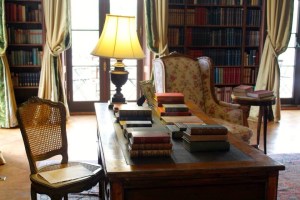
In May 2014, my friend, Avery, and I took a Literary Road Trip across Massachusetts.  We visited the homes of Edith Wharton, Louisa May Alcott, Emily Dickinson and Nathaniel Hawthorne.  My favorite literary home was The Mount in Lenox, where Edith Wharton lived for ten years.  Author of the well-received The Decoration of Houses (1897), she designed and decorated the house herself.  Set in the Berkshires, the estate’s grounds and gardens are just as lovely as the elegant home.  I took many photos during our pleasant afternoon, including these pictures of Edith’s library and garden. 


Clarissa stands in front of her floor to ceiling bookshelves.  Behind her, a cheerful fire crackles in the grate.  A persistent rain taps at the windows, but the softly lit room is warm and cozy.

Drawing her cardigan sweater more closely around her narrow shoulders, she lets her gaze sweep across her library.  Catching a glimpse of her weary countenance reflected in the glass doors that open out onto her veranda, she sighs and combs her elegantly manicured fingers through her disheveled silver bob. After three weeks traveling around New England to promote her newest cookbook, she is back home at last.

As the library door swings open with a gentle squeak, Clarissa turns to smile at her secretary, who sets a tea tray on a low table in front of the fire.  The tantalizing scent of cinnamon drifts across the room.

“Hello, Lydia. Something smells delicious,” Clarissa says.

“Cook tried out your new recipe for cinnamon buns.” Lydia takes a seat by the fire and smooths her wool skirt over her knees.

“Cinnamon buns remind me of Christmas morning,” Clarissa remarks.

Lydia laughs, pouring two cups of tea. “The tour went well?”

“Yes, yes. The audience in Brattleboro was particularly enthusiastic.”  Clarissa joins the younger woman and accepts a cup of tea once she is settled in her favorite William Morris wingback chair. “Everyone seems to be a baker there.”

As she sips her tea and chats with Lydia, Clarissa gazes around the snug room once again. Content to be back among her books, she looks forward to spending the rainy afternoon with a good novel.

gardensWharton

Family Resemblances

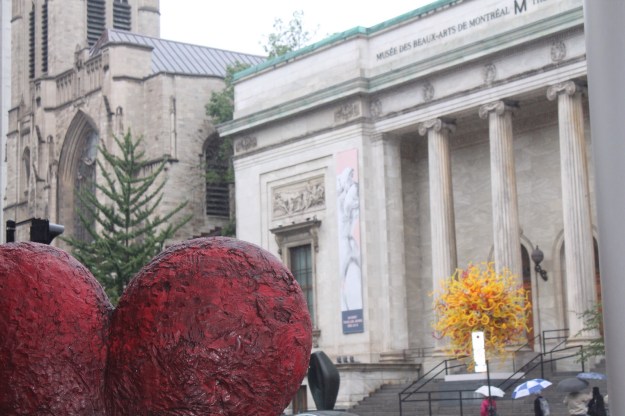
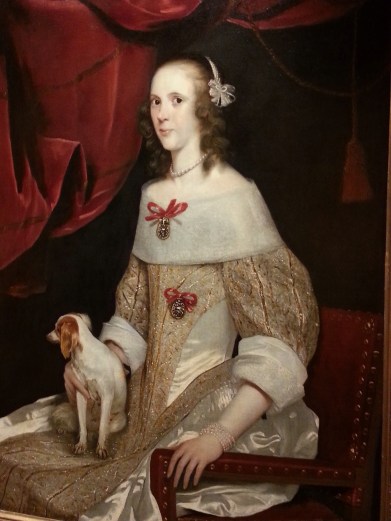
While visiting Montreal in August 2015, my husband and I spent a rainy afternoon in the Musée des Beaux Arts.  We enjoyed strolling through the galleries of Canadian, American and European paintings and inspecting the unique items in the decorative arts collection.  In particular, I admired several intriguing portraits including Abraham van den Tempel’s  seventeenth century painting of Odilia van Wassenaar and her dog.  

img_3304

Musée des Beaux Arts, Montreal (photo by L. Walkins 2015)


Annelise van Strum  hurried  along the rue Sherbrooke clutching her umbrella.  The red and yellow tulips decorating the rim of its clear plastic bubble danced in front of her eyes as she splashed through puddles on her way to the Musée des Beaux Arts.  She didn’t mind the weather.  A rainy day was ideal for exploring the museum galleries.

She was on a special quest this afternoon.  For the past few months she had been  researching their  family tree for her mother.  She had traced the family line all the way back to seventeenth century Holland.  Just that morning she had discovered that the portrait of one of her ancestors was hanging in the fine arts museum around the corner from her apartment.

Pulling her umbrella closed as she stepped into the museum lobby, Annelise handed it over to the girl behind the coat check counter.

Passez une bonne visite,” the girl said with a smile.

Merci.”  Annelise accepted the thick plastic disk numbered 143.

img_3276

Portrait of  Odilia van Wassenaar, Montreal Museum of Fine Arts (photo by L. Walkins 2015)

Making her way to the Hornstein Pavilion for Peace where works from the Dutch Golden Age were on display, Annelise wondered what her ancestor Odilia’s life was like.  She located the correct gallery and began perusing the portraits hung around the softly lit room.  The expressive faces painted hundred of years earlier by the Dutch masters peered out from their frames.

At last, Annelise paused and looked into the eyes of a young woman seated in a sturdy chair with a small dog on her lap.  The girl looked to be in her twenties.  Her light chestnut hair and dark eyes were of the same coloring as Annelise’s own.

The plaque beneath the painting identified it as Portrait of  Odilia van Wassenaar.  Stepping back and hugging herself, Annelise murmured, “There she is, my tenth great-grandmother.”

Annelise carefully examined the painting, searching for clues about who Odilia was exactly.  The gold trinkets adorning her ornate fur-trimmed gown and the pearls encircling her throat and wrist spoke to a wealthy upbringing. Odilia wore an intelligent, almost mischievous expression on her pale face.  The way she cradled her dog gently on her lap convinced Annelise that her ancestor must have had a kind heart.

Raising her cell phone, Annelise snapped three photos of the painting.  Odilia’s portrait reminded her of an old black and white photo of Aunt Phillipa, her mom’s older sister.  In a family album, there was a picture of Phillipa, aged 15, with their Jack Russell terrier sitting on the front stoop of their childhood home.  Phillipa and Odilia might almost be twins.

Annelise laughed softly to herself as she retrieved her umbrella and made her way home. The rain had stopped but the pavement still gleamed with puddles that reflected the clearing sky.

She felt like she had connected with a long-lost relative and couldn’t wait to show the photos to her mother.  Together, they could go online to find out more about Odilia and her family . . . their family.


Life is good

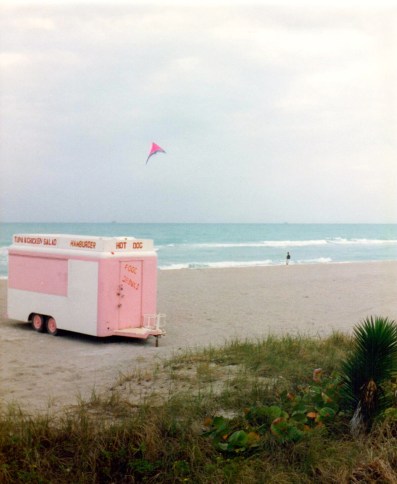
When I was in my late twenties, my friends and I took a vacation to Miami, Florida.  We took a cruise to nowhere, explored the shops at the Bayside Marketplace and Coconut Grove, visited a historical home called Villa Viscaya and of course spent time on the beach. One afternoon I spotted a pink hotdog stand on the sand.  Down near the water, a man was flying a bright pink kite.  The color combination provided a tempting photo opportunity.  Later, while looking through my  vacation album, I wrote the descriptive piece below.

miami

Miami Beach, March 1991 (photo by L. LeVasseur)

Brushing her hair out of her eyes, Juliette watches him from the boardwalk.  His fluorescent pink kite is a solitary point of color in the overcast sky.  The kite hovers on the horizon and then plummets toward the rolling waves.  She feels her pulse quicken and her freckled face flush as the kite dives toward the blue-green surf.  But with a determined flick of his wrist he stops its abrupt descent and sends it soaring in the strengthening breeze.

She breathes out a sigh of relief and sets the picnic basket she has brought with her on one of the tables surrounding the cheerful pink hotdog stand, which has closed for the day.  Perhaps they will come back tomorrow at noon and have hot dogs and curly fries for lunch like teen-agers.  Now, they will content themselves with her home-made macaroni salad, deviled eggs and apple pie.

Pulling her denim jacket closer around her slight frame, she waves as Leo catches sight of her.  He reels in the kite, walking slowly up the beach to where she waits. He looks relaxed and comfortable in his shorts and snug windbreaker.  She notes that he must have gone to the barber and admires his closely cropped graying hair.

He greets her with a kiss and says, “Hello there.  How was your last day of school?”

She smiles a little sadly.  “It was fine.  The kids gave me farewell gifts and they all said they would miss me next year.  The teachers surprised me with a cake in the faculty room at lunch.”

“I’m glad they appreciate you,” he says, opening the picnic basket and helping her set out their supper.  “You’ve certainly devoted many years to the school.”

She nods and holds out her hand for his plate.  She puts a mound of macaroni salad on the plate and asks, “How was your first day of retirement?  What did you do all day?”

Helping himself to two deviled eggs, he says, “I had a great day.  I read the paper and worked in the garden this morning.  After lunch, I ran into town to do some errands and now I’m here enjoying a delicious supper with my beautiful wife.  Life is good.”

Juliette gives him a fond smile and as they eat, they laugh and talk, making plans for the next day and the months ahead.  They will spend time with their grandchildren.  Leo will plant more roses in the garden.  Juliette will take up quilting again.  They will travel to France and visit the village where her parents met and fell in love.

At last, they both take a final bite of the sweet and spicy apple pie.  They pack up the remains of the picnic and stroll hand-in-hand down to the water’s edge where he launches the bright pink kite once again over the ocean.

Una camera con vista

In February, I was fortunate enough to visit my niece in Florence, Italy.  For five marvelous days, we toured churches and museums, feasted on pasta and gelato, and wandered the narrow streets photographing the sights of this charming and friendly city.  

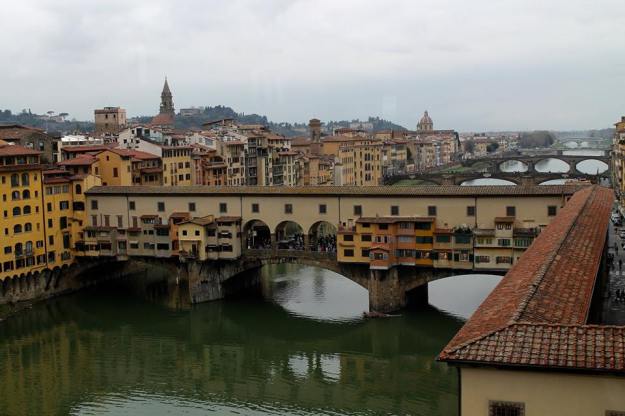
Each morning, I began my adventures by crossing the Arno on the aptly named Ponte Vecchio, the oldest bridge in Firenze, renowned for the jewelry shops lining both sides of the street.  The center of the bridge was an ideal spot to capture the splendid views of the river.

roomwithaview

Ponte Vecchio, Florence Italy (photo by L. Walkins 2017)

Lucie Hartgrove turned the page of her novel and glanced up for a moment to drink in the panorama of the Arno from her hotel balcony.   The late afternoon sun cast spangles of light across the surface of the greenish-grey river and a golden glow over the buildings lining the riverbank.  A reflection of the  haphazard row of jewelry shops clinging to the side of the Ponte Vecchio undulated in the slowly moving water below.

With a sigh of contentment, she lowered her eyes to her book, delighted to be reading E.M. Forster’s A Room with a View in her own hotel room in Florence.  Lucy Honeychurch was one of her favorite literary characters.  The first time she read Forster’s novel in the eighth grade, she was amazed at how much Lucy was just like her.  They both had long dark hair and a pale complexion.  They both played the piano to forget their worries, and Lucie was certain she also would have fainted in  the piazza after witnessing the brutal stabbing of the poor Italian man.

Ever since then, Lucie had longed to visit Florence.  Finally, on her first college spring break, she was actually here, and she had a fantastic view.  That morning, she had visited the Basilica di Santa Croce. Eager to retrace Lucy’s steps, she admired the frescoes painted hundreds of years ago by Giotto and examined the tombstones paving the floor of the nave.  After lunch at a tiny, fragrant pizza shop, she returned to her hotel to read for an hour.

As she reached the end of the chapter in which Miss Honeychurch and her party of friends return from their pastoral drive into the Tuscan hills, Lucie closed the book and stood to peer over the railing of her balcony.  She watched a group of tourists who had stopped to take pictures.  Most of them held their cell phones out in front of them, trying to capture themselves in a selfie with the Ponte Vecchio.  Did they even appreciate the history and beauty of the scene?

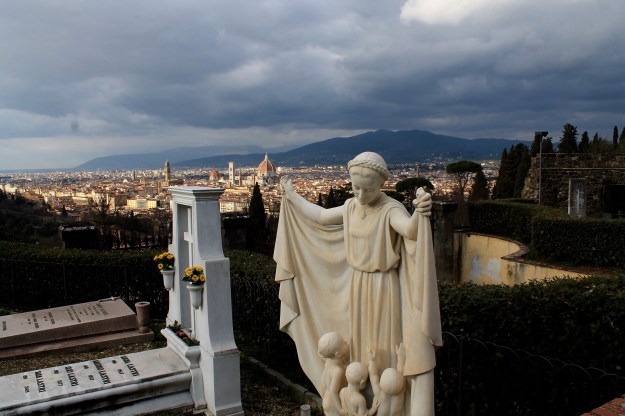
Lucie picked up her book and went back inside.  She put on her walking shoes, grabbed her camera and her room key.  She was going to set off on her own journey into the hills overlooking Florence.  She wanted to hike up to San Miniato al Monte in time for the sunset.  High above the city, the views would be spectacular.

IMG_2822

View from San Miniato al Monte, Florence, Italy (photo by L. Walkins 2017)


Quintessential Sketches

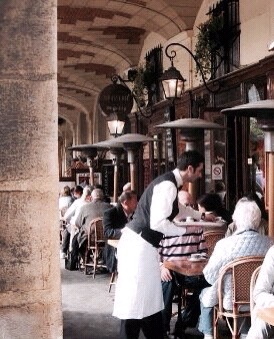
Paris is known for its atmospheric sidewalk cafés.  Locals and tourists lounge at the small tables, sample delicious French fare and watch the world pass by.  In 2008, my husband and I stayed in a wonderful hotel near the Place des Vosges.  This lively square, formerly called Place Royale and one of the oldest in the city, is home to art galleries, shops and restaurants, as well as the Maison de Victor Hugo museum.  While we were strolling through the park on a sunny afternoon, I snapped this picture of a busy café.

Place des Vosges 2008 (photo by L. Walkins)

From her strategic spot in the northeast corner of the Place des Vosges, Camille has a fine view of the outdoor café.  Through the arch of the stone arcade, she glimpses a trio of round tables, two of them empty and the third occupied by a pair of chic girls.  Camille admires their floral sundresses and the silk scarves wrapped insouciantly around their necks.

One of the girls  waves her slim hands about and leans forward, her heart-shaped, freckled face luminous with delight.  Listening with a smile on her face, the other girl tucks her bobbed auburn hair behind her ears, and bursts into peals of laughter. Camille wonders if they are sisters or simply best friends.

Opening the sketch book on her lap, Camille takes a Faber pencil from the small backpack on the bench beside her.  She pauses to think about what Claude, her art instructor said this morning in class.  He wants her to sketch a quintessential scene that captures the Parisian spirit.  What could be more Parisian than a sunny afternoon relaxing at a sidewalk café?

A waiter materializes to lay plates of neatly folded crêpes before the girls.  Camille studies his classic profile and slightly shaggy dark hair.  He wears black and white just as she imagines a proper Parisian waiter would.  Setting pencil to paper, Camille begins to sketch.  With fluid, easy strokes she captures the flirtatious glances of the girls and the faint dimple in the waiter’s clean-shaven cheek.   She frames her models with the outline of the arcade and adds some details.  At last, she looks up and then back down at her drawing.  With a satisfied nod, she carefully closes her sketch book.

Leaning back against the weathered wooden slats of the park bench Camille glances around her.  A black and a grey poodle chase each other around a graceful fountain.  One of the little dogs leaps up and trots along the rim of the basin as sparkling drops of water rain down.  The poodle stops to shake its damp curly coat and tumbles into the pool with a surprised yelp.   Camille laughs and wonders if she should submit a sketch of the poodles to her instructor instead.

A cellist sits on a stool beneath the shade of the chestnut trees.  As if providing a soundtrack for the cavorting poodles, he plays “Carnival of the Animals.”  Humming along to the music as the dog scrambles out of the fountain, Camille files away the ironic moment.  She will tell her sister, who loves Saint Saens, all about it later tonight when she calls home.

Across the park, the dormer windows of Victor Hugo’s brick home gleam beneath the bright blue sky.  Camille imagines the author emerging through the front door of No. 6 to clear his head with a brisk walk around the park after an intense session with Fantine and the unfortunate poor of nineteenth century Paris.  Perhaps he would be in search of a sustaining meal.

Camille turns her attention once again to the café.  The girls sit back in their chairs sipping wine.  The waiter takes an order from an elderly couple, who hold hands across the table.  Camille stands and walks briskly toward the restaurant.  Enjoying a  sustaining meal herself will be the ideal way to cap off her quintessential afternoon.

Make a Wish

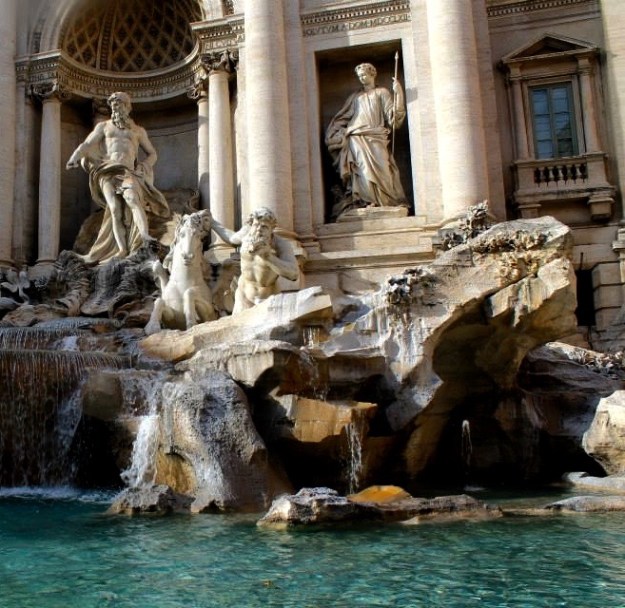
When my niece spent a semester studying in Rome, of course I had to visit her.  We had a marvelous time.  On our first day, we hit many of the popular tourist sights, beginning with the Pantheon, where we marveled at the ingenuity of ancient architects.  A few blocks away is the magnificent Trevi Fountain (pictured below), where visitors flock to throw a coin over their shoulder into the crystalline waters flowing from the imposing marble sculpture portraying Triton and Oceanus. Someday, I hope to return to Rome to make a wish at the Trevi Fountain. 

trevifountain-1

Fontana di Trevi, Roma (photo by L. Walkins 2014)

Elinor can hear the rush of moving water even before she enters the Piazza di Trevi.  Hurrying along the narrow sidewalk, she dodges swinging briefcases and over-size pocketbooks carried by Roman commuters.  At last, she breaks free from the crowd and stands still at the edge of the historic square.  Before her, the splendid fountain glows in the morning sunshine, the magnificent marble figures glowing, the pool of water dappled with spangles of light.

Hands on her hips, she scans  the square and spots a slim figure, wearing a swirling floral dress.  The girl perches on the low fountain wall and dips her hand into the water.  She leans too far and nearly tumbles into the pool.

“Maggie?” Elinor calls, shaking her head and walking briskly to join her younger sister. They haven’t seen each other since Maggie departed for her year abroad in September.

“Elinor!  I can’t believe you’re here,” Maggie shrieks as she leaps up and wraps her in an enthusiastic hug.  “Thank you so much for coming to visit me.”

As her sister begins to pull away, Elinor holds the embrace for just a second more, and then steps back to peer into Maggie’s bright blue eyes.  “You look happy.  Rome must agree with you.”

“It does.  School is fabulous.  My apartment is fabulous. My friends are fabulous. Everything is fabulous.”  Maggie links arms with Elinor.  “Are you ready for some sightseeing?  What should we do first?  Climb the Spanish Steps?  Or, I know, let’s go to the Pantheon.  It’s right down the road.”

“Wait, wait.  Slow down a minute.”  Elinor fishes in the pocket of her Shaker-stitch sweater.  “First, let’s make a wish.”

She hands Maggie a round gold and silver Euro, keeping one for herself.  Together, they toss them over their shoulders.  The coins land one after another with a satisfying splash.

“Do you think our wishes will come true?” Maggie wonders.

“Of course they will,” Elinor assures her as the coins drift lazily to the bottom of the fountain.


A Bit of Highland Romance

In 2010, my cousin and I went on a scenic day trip around the West Highlands in Scotland.  One of our tour stops was Loch Katrine in the Trossachs, the setting of  Sir Walter Scott’s narrative poem “The Lady of the Lake.” We spent a lovely hour strolling by the lakeside and taking photos before heading off to Stirling Castle.

lochkatrine4

Loch Katrine, Scotland (photo by L. Walkins 2010)

The brisk Highland wind swooped across the sparkling surface of Loch Katrine.  Elizabeth Ann brushed her dark hair from her eyes and settled her heather-colored wool cape more snugly around her shoulders as they waited to board the brightly painted tour boat.

“Chilly?” Sebastian asked, pulling her to his side. His thick fisherman’s sweater radiated warmth like it had just come out of the dryer.  Elizabeth Ann glanced up at him and then at the door of the tea room at the foot of the dock, hoping they would end their day with a snack and something hot to drink.

Maude and Duncan stood behind them in line, holding hands.  Maude pointed to a sign in front of the tea room.  “Hey, look.  We can hire bikes.”

“I haven’t ridden a bicycle since boarding school,” Sebastian said, chuckling.

“What do you think, Duncan?  Do you fancy going for a ride?” Maude asked.  “You don’t mind, Elizabeth Ann?”  She looked imploringly at her friend.  “We’ll meet you two back in the tea room, okay?”

“What about the boat tour? Elizabeth Ann asked.

“Right.  What about the boat?” Duncan echoed.

“They can tell us what we missed,” Maude said and tugged on Duncan’s arm.  “I really want to stretch my legs, darling, and get a bit of exercise,” she added, pulling him out of line  and then raising her eyebrows at Sebastian.

Elizabeth Ann watched their friends go and said, “What was that all about?”

Sebastian shrugged, put one hand in his jacket pocket and the other on the small of her back to guide her onto the boat.

Once they were settled on a wide wooden bench on the starboard side of the cruiser, Sebastian said, “The name of this vessel is Lady of the Lake.  Did you know that Sir Walter Scott wrote that poem after he and his family were on holiday right here at Loch Katrine?”

“The Lady of the Lake?” Elizabeth Ann asked absently, focusing on the view of Ben A’an as the boat glided smoothly down the lake.  She raised her camera and snapped a picture of the rugged stone peak.

“It’s one of his most romantic poems,” Sebastian explained.  “He was inspired by this gorgeous setting.”  The boat floated past a tiny densely wooded island. “There’s Ellen’s Isle,” he pointed out.  “Named for Scott’s heroine, Ellen Douglas.”

Elizabeth Ann took a quick picture and then rose to her feet.  Sebastian caught her by the hand. “Wait,” he said.

“I just want to get a few more pictures,” Elizabeth Ann said, squeezing his hand.

“The photos can wait,” he said standing beside her.  “Please sit for a moment.”

“But . . .”

“Please?” He met her gaze, an expression in his eyes she had never seen before.

With a bemused smile, she sat and put her camera on the bench beside her.  She widened her eyes as Sebastian fumbled in his jacket pocket and then dropped down on one knee.  Elizabeth Ann pressed trembling fingers against her mouth as he cleared his throat.

“Ellen Douglas and her suitor, Malcolm Graeme, found true love on the shores of this loch.  I can think of nowhere more romantic to ask you this very important question.”  Sebastian held out a small velvet box.  Nestled inside was a glittering princess-cut diamond ring.

“Oh, Sebastian,” Elizabeth Ann whispered.

“Will you be my wife, Elizabeth Ann Martini?”

She nodded silently, tears filling her eyes, and Sebastian slid the ring onto her finger.

“Brilliant!” He leapt up and pulled her into a massive hug.

They shared a kiss and then he began to laugh.  On the shore, two bicyclists waved enthusiastically.  Elizabeth Ann held up her left hand.  “We’re getting married,” she happily called out to Maude and Duncan.

A short time later, the Lady of the Lake returned to the pier.  Elizabeth Ann and Sebastian were the first to disembark.  Hand-in-hand, they hurried toward the tea room to bask in the congratulations from their friends and the restoring warmth of a good cup of tea.

Capturing a Moment

My favorite beach is located on Bermuda’s South Shore.  Lounge chairs shaded by jaunty pink-striped umbrellas line the soft coral sand and graceful longtails fly back and forth from the cliffs that cup the serene bay.  High above the beach perches one of Bermuda’s most popular resorts, The Reefs.  

I have been a guest at The Reefs several times.  On one of my trips, I took this snapshot of the beach and later composed a photo essay inspired by my memories of Bermuda.

reefsbeach

Beach at The Reefs (photo by L. Walkins, 2007)

The ocean glitters with sun pennies and the water slowly changes shades from indigo to turquoise until it becomes white foam at the shore.  The  Bermuda longtails float on the breeze in a graceful ballet, filling the early morning air with their distinctive whistling call.

Click. Standing in the powder soft sand, Miranda presses the shutter button on her digital camera.  Quickly, she checks the display screen and smiles at the image of the quiet beach scene.  Lowering the camera to her side, she gazes for a long moment at the water and listens to the rush of the waves.  A pair of the black and white tropic birds swoop across the horizon before returning to their nests in the cliffs that hug the tiny bay.

Finally, Miranda turns and pads slowly across the beach to the stairs leading to the hotel.  As she heads for the restaurant terrace  where Ted waits for her, she thinks about some of the other beautiful scenes captured on her memory card.  The views from the top of Gibbs Hill Lighthouse.  The stained glass windows in the cathedral in Hamilton.  The sunset shots taken from their hotel balcony.  And her favorite photo of the dolphins playing in their pool at the Shipyard.

Miranda reaches the terrace and spots Ted, who is examining a menu at one of the umbrellaed tables.  A steaming cup of coffee sits at his elbow.  Raising her camera, she studies him through the viewfinder.  He glances up and she snaps his portrait just as he lifts his hand to wave.  The sun glints against the wide gold wedding band he wears.  She smooths her thumb against the unaccustomed ring adorning her own left hand and hurries to join her husband.

Young Girls at the Piano

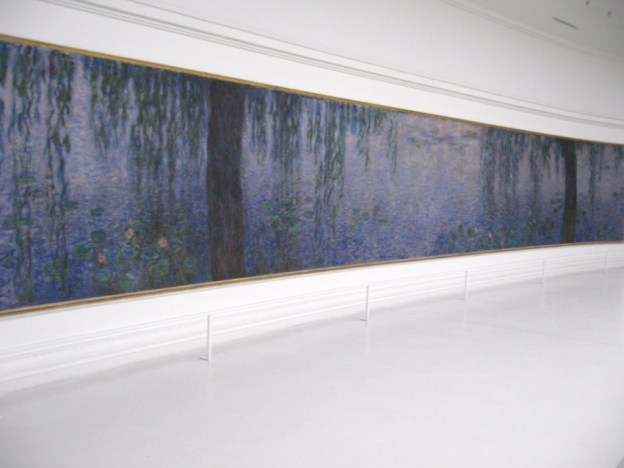
 In college, I took an art history course, studying the Impressionists for one semester.  Since then, I have cultivated my continuing fascination with these artists through travel.  In cities like Chicago,  Washington D.C., Rome and naturellement, Paris, I have stood in front of some of my favorite paintings, masterpieces of color and light.  The last time I was in Paris, I strolled through the Jardin des Tuileries and then enjoyed a couple of lovely hours in the Musée de l’Orangerie.  After marveling over Claude Monet’s celebrated waterlily panels, I ventured on to view the works of other Impressionists like Pierre-Auguste Renoir.  This cheerful portrait of two girls at the piano caught my eye and inspired my latest photo essay.

renoir2010

Jeunes Filles au Piano painted by Renoir  (Photo by L. Walkins 2010)

Bright laughter mingles with the lilting melody of the French folk song Sophie plays on her grandmama’s piano.  That morning, she had sent a note to her cousin, Marguerite, suggesting an afternoon stroll and a picnic in the Jardin des Tuileries.  At noon, the skies had insisted on turning dark and ominous, and now, a steady rain rattles against the window panes behind the long damask curtains.

Settling for a pot of creamy hot chocolate and a plate of Cook’s lemon madeleines in the parlor, the girls make the most of their unexpected afternoon indoors by sifting through the stacks of sheet music, collected over the years by their grandmother, and playing their favorite pieces.  Both Sophie and Marguerite have studied the piano ever since they can remember, taking lessons from the formidable M. Chanson.

Sophie’s slim fingers skip across the ivory keys and Marguerite begins to sing the simple tune in her sweet soprano voice.  Sophie wishes she sang as well as Marguerite, but her voice is passable at best.  Upon playing the final measure, Sophie slides over on the piano bench, making room for her cousin.

“You play something now,” Sophie says. “How about that new piece by Debussy? I absolutely adore the third movement, Clair de Lune.” She finds the music and spreads it out across the piano’s polished music stand.

Marguerite leans forward to study the opening bars and says, “Did you know that Grandmama once had Mr. Debussy over to dine?”  She begins to play, her fingers traveling gently and expertly over the keyboard.  “I wonder if he played for everyone after dinner.”

“Can you imagine if we took our lessons from him instead of grumpy old M. Chanson?” Sophie says with a shout of laughter.

She gets up and retrieves her sketchbook from the divan. As Marguerite plays, Sophie sketches her, her pencil flying confidently over the page.  She finishes the drawing just as her cousin strikes the final notes of Mr. Debussy’s piece.

Marguerite turns around on the piano bench and Sophie holds up her sketch.

“I wish I could play as well as you,” Sophie says and Marguerite echoes back, “I wish I could draw as well as you.”

The cousins share another laugh and go together to the window.  The rain has stopped and hopeful rays of sunshine break through the clouds.


Life in Miniature

IMG_1298

English Cottage Kitchen, Thorne Collection (photo by L. Walkins 2010)

My favorite gallery at the Art Institute in Chicago houses a collection of miniature rooms commissioned by Mrs. James Ward Thorne (Narcissa), who turned her childhood fascination with dollhouses into a life-long vocation to recreate in meticulous detail a variety of decorative interiors from England, France and the United States.  I stumbled upon the Thorne gallery at the end of our museum visit, so I had time to view just a few of the beautiful dioramas, including these two reproductions of a Virginia Dining Room (circa 1800) and an English cottage kitchen from the Queen Anne period.  Nevertheless, the lovely rooms struck a chord in my imagination and inspired me to write the photo essay below.  

Virginia Dining Room, Thorne Collection (photo by L. Walkins 2010)

“Everything is so tiny and perfect,” Elizabeth Ann said, clasping her hands and staring in wonder at the pale pink dollhouse. “Look Cat, the shelves in the library are even filled with little books.”

She flung her arms around her Aunt Catharine’s waist in a grateful hug and then sat cross-legged on the floor, letting her gaze roam across the three floors of miniature rooms. She couldn’t believe the dollhouse that used to reside under the eaves of Grammy Merriweather’s attic next door to a gigantic steamer trunk now filled the corner of her very own bedroom.  Her aunt had driven it over in the back of the station wagon while Elizabeth Ann was at school.

Cat knelt down beside her and affectionately tugged one of her dark braids.  “I hope you were surprised.”  She grinned as Elizabeth Ann nodded solemnly.  Reaching into her sweater pocket Cat pulled out a package wrapped in tissue paper.  “Here, I almost forgot.  You have to have a family to live in the house, don’t you?”

Eagerly, Elizabeth Ann opened the package and  placed the four china dolls in her lap.  There was a mother, a father and two children in the doll family.  They wore old-fashioned clothes and cheerful smiles.

“I think the boy and the girl are twins,” Cat said.

“Like me and Edmund,” Elizabeth Ann observed, holding the children up, one in each hand. “They do look alike.”

“So, which room do you like best?” Cat asked.  “My favorite has always been the dining room. The wallpaper is such a pretty shade of blue and the chandelier adds just the right touch of elegance.”

Beginning with the basement kitchen filled with sturdy wooden chairs and cunning pitchers and plates, Elizabeth Ann considered each room,  tapping her finger against pursed lips. Cat was right about the dining room.  It was really pretty, but so was the living room. The long couch with its  needle-point pillows and a hand-knit afghan looked so comfortable.  Each of the four bedrooms on the second floor had beautiful flowered wallpaper and carpets. Plus, everyone in the doll family got to sleep in a canopied bed.

Glancing at her neatly made twin bed by the window, Elizabeth Ann sighed and then returned her attention to the doll family’s house.  At last, she came to a decision.  “I think the music room is my favorite,” she said. “I wish we had grand piano like that one for my mom to play.”

“That’s very sweet of you, hon.”

Elizabeth Ann turned around at the sound of her mother’s voice.  “I think it was sweet of Aunt Cat to bring me her dollhouse.  Is it really mine to keep?”

“Of course,” Mom and Aunt Catharine said at the same time.  They both laughed and added, “Jinx! You owe me a Coke.”

“Actually, the coffee’s ready, Cat,” Mom said.  “And I just took some peanut butter cookies out of the oven, Elizabeth Ann.”

“Mmm, I can smell them from here,” Cat said, standing beside Mom in the doorway.  “We’d better go and get some before Edmund comes in and eats them all.”

“I’ll be there in a minute,” Elizabeth Ann said.

Carefully, she sat each member of the doll family around their miniature  dining room table. “You wait here,” she said and then got up to follow her mother and aunt to her own sunny kitchen.

As she skipped down the hallway, Elizabeth Ann’s imagination overflowed with stories of  the old-fashioned china doll’s adventures in their pale pink home.