Category Archives: travel

Una camera con vista

In February, I was fortunate enough to visit my niece in Florence, Italy.  For five marvelous days, we toured churches and museums, feasted on pasta and gelato, and wandered the narrow streets photographing the sights of this charming and friendly city.  

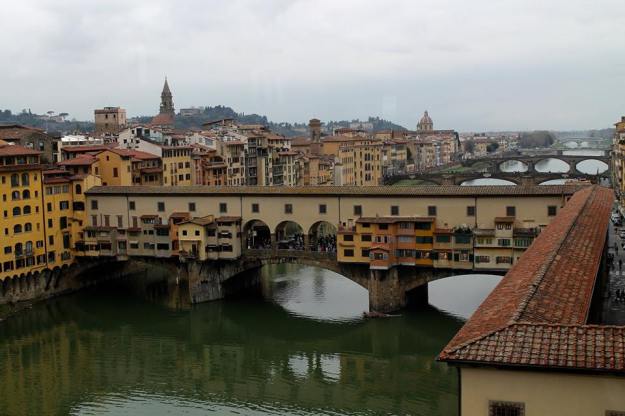
Each morning, I began my adventures by crossing the Arno on the aptly named Ponte Vecchio, the oldest bridge in Firenze, renowned for the jewelry shops lining both sides of the street.  The center of the bridge was an ideal spot to capture the splendid views of the river.
roomwithaview

Ponte Vecchio, Florence Italy (photo by L. Walkins 2017)

Lucie Hartgrove turned the page of her novel and glanced up for a moment to drink in the panorama of the Arno from her hotel balcony.   The late afternoon sun cast spangles of light across the surface of the greenish-grey river and a golden glow over the buildings lining the riverbank.  A reflection of the  haphazard row of jewelry shops clinging to the side of the Ponte Vecchio undulated in the slowly moving water below.

With a sigh of contentment, she lowered her eyes to her book, delighted to be reading E.M. Forster’s A Room with a View in her own hotel room in Florence.  Lucy Honeychurch was one of her favorite literary characters.  The first time she read Forster’s novel in the eighth grade, she was amazed at how much Lucy was just like her.  They both had long dark hair and a pale complexion.  They both played the piano to forget their worries, and Lucie was certain she also would have fainted in  the piazza after witnessing the brutal stabbing of the poor Italian man.

Ever since then, Lucie had longed to visit Florence.  Finally, on her first college spring break, she was actually here, and she had a fantastic view.  That morning, she had visited the Basilica di Santa Croce. Eager to retrace Lucy’s steps, she admired the frescoes painted hundreds of years ago by Giotto and examined the tombstones paving the floor of the nave.  After lunch at a tiny, fragrant pizza shop, she returned to her hotel to read for an hour.

As she reached the end of the chapter in which Miss Honeychurch and her party of friends return from their pastoral drive into the Tuscan hills, Lucie closed the book and stood to peer over the railing of her balcony.  She watched a group of tourists who had stopped to take pictures.  Most of them held their cell phones out in front of them, trying to capture themselves in a selfie with the Ponte Vecchio.  Did they even appreciate the history and beauty of the scene?

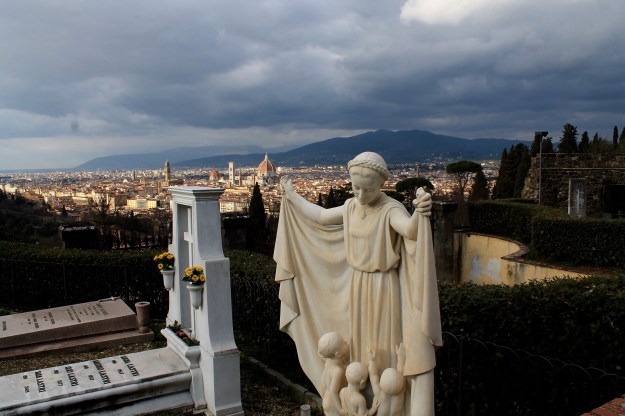
Lucie picked up her book and went back inside.  She put on her walking shoes, grabbed her camera and her room key.  She was going to set off on her own journey into the hills overlooking Florence.  She wanted to hike up to San Miniato al Monte in time for the sunset.  High above the city, the views would be spectacular.
IMG_2822

View from San Miniato al Monte, Florence, Italy (photo by L. Walkins 2017)


Quintessential Sketches

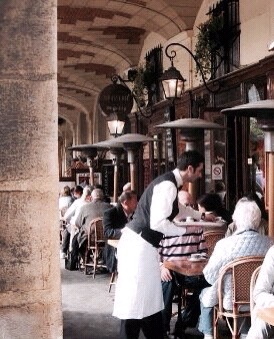
Paris is known for its atmospheric sidewalk cafés.  Locals and tourists lounge at the small tables, sample delicious French fare and watch the world pass by.  In 2008, my husband and I stayed in a wonderful hotel near the Place des Vosges.  This lively square, formerly called Place Royale and one of the oldest in the city, is home to art galleries, shops and restaurants, as well as the Maison de Victor Hugo museum.  While we were strolling through the park on a sunny afternoon, I snapped this picture of a busy café.

Place des Vosges 2008 (photo by L. Walkins)

From her strategic spot in the northeast corner of the Place des Vosges, Camille has a fine view of the outdoor café.  Through the arch of the stone arcade, she glimpses a trio of round tables, two of them empty and the third occupied by a pair of chic girls.  Camille admires their floral sundresses and the silk scarves wrapped insouciantly around their necks.

One of the girls  waves her slim hands about and leans forward, her heart-shaped, freckled face luminous with delight.  Listening with a smile on her face, the other girl tucks her bobbed auburn hair behind her ears, and bursts into peals of laughter. Camille wonders if they are sisters or simply best friends.

Opening the sketch book on her lap, Camille takes a Faber pencil from the small backpack on the bench beside her.  She pauses to think about what Claude, her art instructor said this morning in class.  He wants her to sketch a quintessential scene that captures the Parisian spirit.  What could be more Parisian than a sunny afternoon relaxing at a sidewalk café?

A waiter materializes to lay plates of neatly folded crêpes before the girls.  Camille studies his classic profile and slightly shaggy dark hair.  He wears black and white just as she imagines a proper Parisian waiter would.  Setting pencil to paper, Camille begins to sketch.  With fluid, easy strokes she captures the flirtatious glances of the girls and the faint dimple in the waiter’s clean-shaven cheek.   She frames her models with the outline of the arcade and adds some details.  At last, she looks up and then back down at her drawing.  With a satisfied nod, she carefully closes her sketch book.

Leaning back against the weathered wooden slats of the park bench Camille glances around her.  A black and a grey poodle chase each other around a graceful fountain.  One of the little dogs leaps up and trots along the rim of the basin as sparkling drops of water rain down.  The poodle stops to shake its damp curly coat and tumbles into the pool with a surprised yelp.   Camille laughs and wonders if she should submit a sketch of the poodles to her instructor instead.

A cellist sits on a stool beneath the shade of the chestnut trees.  As if providing a soundtrack for the cavorting poodles, he plays “Carnival of the Animals.”  Humming along to the music as the dog scrambles out of the fountain, Camille files away the ironic moment.  She will tell her sister, who loves Saint Saens, all about it later tonight when she calls home.

Across the park, the dormer windows of Victor Hugo’s brick home gleam beneath the bright blue sky.  Camille imagines the author emerging through the front door of No. 6 to clear his head with a brisk walk around the park after an intense session with Fantine and the unfortunate poor of nineteenth century Paris.  Perhaps he would be in search of a sustaining meal.

Camille turns her attention once again to the café.  The girls sit back in their chairs sipping wine.  The waiter takes an order from an elderly couple, who hold hands across the table.  Camille stands and walks briskly toward the restaurant.  Enjoying a  sustaining meal herself will be the ideal way to cap off her quintessential afternoon.

Make a Wish

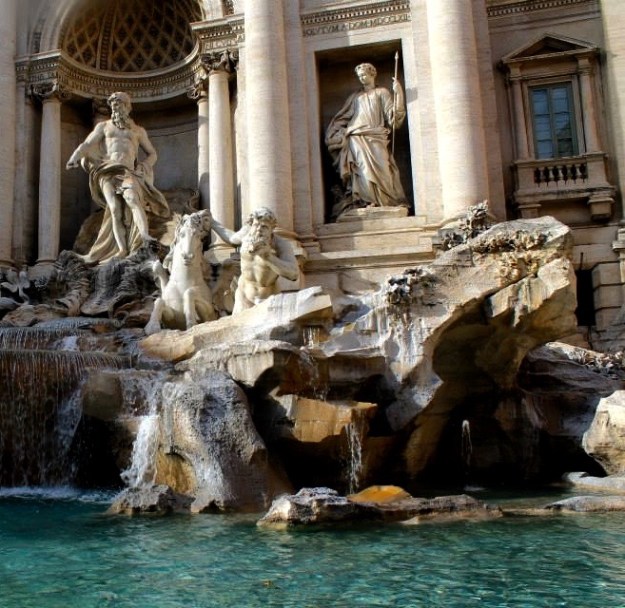
When my niece spent a semester studying in Rome, of course I had to visit her.  We had a marvelous time.  On our first day, we hit many of the popular tourist sights, beginning with the Pantheon, where we marveled at the ingenuity of ancient architects.  A few blocks away is the magnificent Trevi Fountain (pictured below), where visitors flock to throw a coin over their shoulder into the crystalline waters flowing from the imposing marble sculpture portraying Triton and Oceanus. Someday, I hope to return to Rome to make a wish at the Trevi Fountain. 

trevifountain-1

Fontana di Trevi, Roma (photo by L. Walkins 2014)

Elinor can hear the rush of moving water even before she enters the Piazza di Trevi.  Hurrying along the narrow sidewalk, she dodges swinging briefcases and over-size pocketbooks carried by Roman commuters.  At last, she breaks free from the crowd and stands still at the edge of the historic square.  Before her, the splendid fountain glows in the morning sunshine, the magnificent marble figures glowing, the pool of water dappled with spangles of light.

Hands on her hips, she scans  the square and spots a slim figure, wearing a swirling floral dress.  The girl perches on the low fountain wall and dips her hand into the water.  She leans too far and nearly tumbles into the pool.

“Maggie?” Elinor calls, shaking her head and walking briskly to join her younger sister. They haven’t seen each other since Maggie departed for her year abroad in September.

“Elinor!  I can’t believe you’re here,” Maggie shrieks as she leaps up and wraps her in an enthusiastic hug.  “Thank you so much for coming to visit me.”

As her sister begins to pull away, Elinor holds the embrace for just a second more, and then steps back to peer into Maggie’s bright blue eyes.  “You look happy.  Rome must agree with you.”

“It does.  School is fabulous.  My apartment is fabulous. My friends are fabulous. Everything is fabulous.”  Maggie links arms with Elinor.  “Are you ready for some sightseeing?  What should we do first?  Climb the Spanish Steps?  Or, I know, let’s go to the Pantheon.  It’s right down the road.”

“Wait, wait.  Slow down a minute.”  Elinor fishes in the pocket of her Shaker-stitch sweater.  “First, let’s make a wish.”

She hands Maggie a round gold and silver Euro, keeping one for herself.  Together, they toss them over their shoulders.  The coins land one after another with a satisfying splash.

“Do you think our wishes will come true?” Maggie wonders.

“Of course they will,” Elinor assures her as the coins drift lazily to the bottom of the fountain.


A Bit of Highland Romance

In 2010, my cousin and I went on a scenic day trip around the West Highlands in Scotland.  One of our tour stops was Loch Katrine in the Trossachs, the setting of  Sir Walter Scott’s narrative poem “The Lady of the Lake.” We spent a lovely hour strolling by the lakeside and taking photos before heading off to Stirling Castle.

lochkatrine4

Loch Katrine, Scotland (photo by L. Walkins 2010)

The brisk Highland wind swooped across the sparkling surface of Loch Katrine.  Elizabeth Ann brushed her dark hair from her eyes and settled her heather-colored wool cape more snugly around her shoulders as they waited to board the brightly painted tour boat.

“Chilly?” Sebastian asked, pulling her to his side. His thick fisherman’s sweater radiated warmth like it had just come out of the dryer.  Elizabeth Ann glanced up at him and then at the door of the tea room at the foot of the dock, hoping they would end their day with a snack and something hot to drink.

Maude and Duncan stood behind them in line, holding hands.  Maude pointed to a sign in front of the tea room.  “Hey, look.  We can hire bikes.”

“I haven’t ridden a bicycle since boarding school,” Sebastian said, chuckling.

“What do you think, Duncan?  Do you fancy going for a ride?” Maude asked.  “You don’t mind, Elizabeth Ann?”  She looked imploringly at her friend.  “We’ll meet you two back in the tea room, okay?”

“What about the boat tour? Elizabeth Ann asked.

“Right.  What about the boat?” Duncan echoed.

“They can tell us what we missed,” Maude said and tugged on Duncan’s arm.  “I really want to stretch my legs, darling, and get a bit of exercise,” she added, pulling him out of line  and then raising her eyebrows at Sebastian.

Elizabeth Ann watched their friends go and said, “What was that all about?”

Sebastian shrugged, put one hand in his jacket pocket and the other on the small of her back to guide her onto the boat.

Once they were settled on a wide wooden bench on the starboard side of the cruiser, Sebastian said, “The name of this vessel is Lady of the Lake.  Did you know that Sir Walter Scott wrote that poem after he and his family were on holiday right here at Loch Katrine?”

“The Lady of the Lake?” Elizabeth Ann asked absently, focusing on the view of Ben A’an as the boat glided smoothly down the lake.  She raised her camera and snapped a picture of the rugged stone peak.

“It’s one of his most romantic poems,” Sebastian explained.  “He was inspired by this gorgeous setting.”  The boat floated past a tiny densely wooded island. “There’s Ellen’s Isle,” he pointed out.  “Named for Scott’s heroine, Ellen Douglas.”

Elizabeth Ann took a quick picture and then rose to her feet.  Sebastian caught her by the hand. “Wait,” he said.

“I just want to get a few more pictures,” Elizabeth Ann said, squeezing his hand.

“The photos can wait,” he said standing beside her.  “Please sit for a moment.”

“But . . .”

“Please?” He met her gaze, an expression in his eyes she had never seen before.

With a bemused smile, she sat and put her camera on the bench beside her.  She widened her eyes as Sebastian fumbled in his jacket pocket and then dropped down on one knee.  Elizabeth Ann pressed trembling fingers against her mouth as he cleared his throat.

“Ellen Douglas and her suitor, Malcolm Graeme, found true love on the shores of this loch.  I can think of nowhere more romantic to ask you this very important question.”  Sebastian held out a small velvet box.  Nestled inside was a glittering princess-cut diamond ring.

“Oh, Sebastian,” Elizabeth Ann whispered.

“Will you be my wife, Elizabeth Ann Martini?”

She nodded silently, tears filling her eyes, and Sebastian slid the ring onto her finger.

“Brilliant!” He leapt up and pulled her into a massive hug.

They shared a kiss and then he began to laugh.  On the shore, two bicyclists waved enthusiastically.  Elizabeth Ann held up her left hand.  “We’re getting married,” she happily called out to Maude and Duncan.

A short time later, the Lady of the Lake returned to the pier.  Elizabeth Ann and Sebastian were the first to disembark.  Hand-in-hand, they hurried toward the tea room to bask in the congratulations from their friends and the restoring warmth of a good cup of tea.

Capturing a Moment

My favorite beach is located on Bermuda’s South Shore.  Lounge chairs shaded by jaunty pink-striped umbrellas line the soft coral sand and graceful longtails fly back and forth from the cliffs that cup the serene bay.  High above the beach perches one of Bermuda’s most popular resorts, The Reefs.  

I have been a guest at The Reefs several times.  On one of my trips, I took this snapshot of the beach and later composed a photo essay inspired by my memories of Bermuda.

reefsbeach

Beach at The Reefs (photo by L. Walkins, 2007)

The ocean glitters with sun pennies and the water slowly changes shades from indigo to turquoise until it becomes white foam at the shore.  The  Bermuda longtails float on the breeze in a graceful ballet, filling the early morning air with their distinctive whistling call.

Click. Standing in the powder soft sand, Miranda presses the shutter button on her digital camera.  Quickly, she checks the display screen and smiles at the image of the quiet beach scene.  Lowering the camera to her side, she gazes for a long moment at the water and listens to the rush of the waves.  A pair of the black and white tropic birds swoop across the horizon before returning to their nests in the cliffs that hug the tiny bay.

Finally, Miranda turns and pads slowly across the beach to the stairs leading to the hotel.  As she heads for the restaurant terrace  where Ted waits for her, she thinks about some of the other beautiful scenes captured on her memory card.  The views from the top of Gibbs Hill Lighthouse.  The stained glass windows in the cathedral in Hamilton.  The sunset shots taken from their hotel balcony.  And her favorite photo of the dolphins playing in their pool at the Shipyard.

Miranda reaches the terrace and spots Ted, who is examining a menu at one of the umbrellaed tables.  A steaming cup of coffee sits at his elbow.  Raising her camera, she studies him through the viewfinder.  He glances up and she snaps his portrait just as he lifts his hand to wave.  The sun glints against the wide gold wedding band he wears.  She smooths her thumb against the unaccustomed ring adorning her own left hand and hurries to join her husband.

The Rose

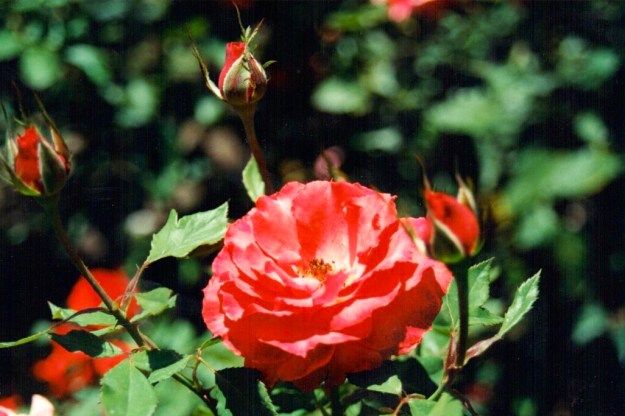
Whenever I travel to Los Angeles, my trip is not complete without spending a glorious afternoon at The Huntington. This remarkable research library established by businessman and financier, Henry E. Huntington, is surrounded by 12 singular botanical gardens. A scenic stroll through the sublime Chinese, Japanese, and Australian landscapes, as well as the Rose, Camellia and Shakespeare gardens must be followed by a visit to at least one of the extraordinary art galleries on the property.  Huntington was a discerning collector of British, French and American art. Of course, the gift shop and the Rose Garden Tea Room are also not to be missed. I took this photo in the Huntington’s Rose Garden and later wrote the accompanying essay.

rose

The Huntington Botanical Gardens, 1990. (Photo by L. LeVasseur)

The roses nod and whisper among themselves of candlelit dinners, weddings and moonlit strolls, as the mellow breeze meanders through the sun-drenched garden.  The soft June air is filled with a hypnotic floral perfume.  In a riot of reds, yellows and pinks, the delicate blossoms cling to the stone wall surrounding a thatched bungalow. A tiny, red bud stretches its furled petals to the cerulean sky.

A buxom, vigorous woman dressed in a faded, cotton sundress and carrying a pair of secateurs, moves briskly through the garden.  She hums a bit of Mozart as she  gathers the sweetest blossoms, placing them carefully in her wicker basket.   With a gentle hand she snips the new rosebud from the vine.

The gardner carries the roses to the end of her winding, dusty lane where she has set up a roadside stand.  Arranging the flowers in bright, hand-painted vases, she places the baby rosebud within a bouquet of elegant pink blooms.  Sitting in the shade of the ancient oaks lining the country road, she waits patiently for  someone to stop and purchase the roses she has tended so lovingly.  She hopes to share their beauty with someone special.

Words and Photos: A Dream Come True


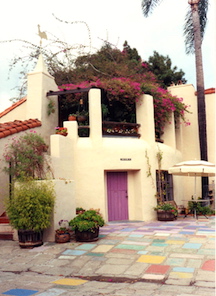
Many years ago, I traveled by train from Los Angeles to San Diego to visit my aunt and uncle.  When I arrived, I wanted to see Balboa Park and spent a delightful afternoon wandering around its Spanish Village Arts Center .    One of the picturesque galleries caught my eye, and the photograph I snapped has inspired this photo essay:

balboapark

Balboa Park, San Diego, CA (photo by L. LeVasseur, 1990)

The small stucco building is draped in flowers and sunshine. Its white walls glow pink in the morning air.  The rooster weathervane glints golden in the delicate light and spins lazily with a faintly musical creak.

Marisa and Joe carry sacks of fresh vegetables across the empty courtyard.  Soon the colorful slate tiles will be covered with umbrellaed tables for guests who prefer to dine beneath the brilliant blue sky.

As Marisa deposits her bags in front of the eclectic lilac door, the inspiration for the name of their new restaurant, Joe fishes the key from his coat pocket.  The door swings open and they stand back to admire the results of all of their planning.

Entering the brightly decorated dining room, she immediately heads for  the kitchen, while he hauls in the bags of produce and then begins to take down the chairs from the sturdy oak tables.  In just a few hours, the hushed tranquility will be replaced with the rush and clamor of their very first lunch hour.  The clatter of silverware, the hum of conversation and the sizzle of the kitchen grills will fill the space, along with the warm and comforting aromas of chilies, cumin and cilantro.

Marisa emerges from the kitchen, her face already smudged with flour.  She has put a batch of churros in the oven.  She and Joe exchange a smile. After years of studying in culinary school and working in other chefs’ kitchens, their dream has finally come true.

Words and Photos: Portraits

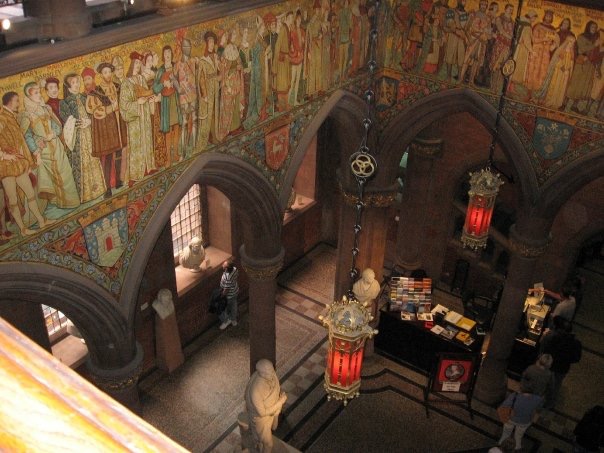
Whenever I visit an art museum, invariably my favorite paintings are the portraits.  I enjoy studying the faces and clothing of the subjects and wondering about their personalities and lives.  Edinburgh has a wonderful National Portrait Gallery  on Queen Street in New Town.  The collection includes pictures of many literary and royal luminaries.  Upon entering the museum’s Great Hall, I always marvel at the gilded murals adorning entrance hall’s balcony.  The procession of Scottish dignitaries includes Stuart kings and queens, poets, scientists and philosophers.  In the short story I am currently writing, my character, Elizabeth Ann, visits the portrait gallery with her friend, Maude and experiences a moment of clarity.

National Portrait Gallery, Edinburgh Scotland.  Photo by L. Walkins, 2006

Photo by L. Walkins, 2006

Outside, wispy clouds stretched across the blue summer sky.  Shoppers and tourists crowded the sidewalks of Castle Street.  Maude and I headed up the block and turned right, walking past the Queen Street gardens.  Behind the wrought iron railings enclosing the park, I glimpsed rolling green lawns and the roof of a Grecian temple.

Maude walked quickly, leading me along the shaded sidewalk.  “It’s a shame Will couldn’t come along on your vacation,” she said, as we approached the National Portrait Gallery.

“He wanted to, but he has a big case going to trial soon.”  My boyfriend, Will was doing  well at his law firm and hoped to make partner soon. Following Maude into the museum, I wondered what Will was doing back in San Diego.  I  looked at  my watch.  With the time difference, he was probably sound asleep.

“Wait here,” Maude said.  “I’ll get us a map.”

I nodded, pausing in the middle of the sumptuous room to look around.  My eyes were drawn to the gilded frieze that decorated the balcony above me. A procession of Scottish dignitaries filled the upper reaches of the hall.  In one corner, I spotted Queen Mary and her consort, Lord Darnley dressed in splendid finery.  The couple stood proudly among the crowd of leaders.  Mary, in particular, looked like she was born to rule.

Maude returned and unfolded the visitor’s map of the different galleries.  “Where shall we begin?” she asked.  “Literary figures or the royals?”

Glancing up at the figure of Queen Mary once more and thinking back to the day Maude and I became friends, I said, “Why don’t we find a portrait of your favorite queen?”

Maude and I had met during my semester abroad at Regent’s College  in London.  Spotting me at Westminster Abbey one Saturday, she reminded me that we shared a public speaking class and insisted we spend the afternoon together.  Taken in by her candor and exuberance, I had followed her into the abbey and right over to the tomb of Mary Queen of Scots.

“Excellent idea,” she said now, consulting the map.  “She’s on the second floor.  Follow me.”

We  climbed the  stairs and found  the Scottish queen’s portrait.  She wore a white hood and veil and looked out at us with sad eyes.

Leaning forward, I read the placard beside the painting.  “It says she’s dressed in traditional French mourning.  It seems weird that white was the color for mourning back then.”

“Poor Mary was absolutely devastated when her French husband died.” Maude fiddled with the end of her long, blonde braid.  “The royal  family had no use for her anymore and they cast her aside.”

“Being a sixteenth century woman was pretty horrible,” I said.  “Can you imagine having no control over your own fate?  Like all those poor women who married Henry VIII.”

“Dreadful.”  Maude folded her arms as she studied the portrait.  “Mary was just 19 when she came home to Scotland to rule.  When I was 19, I had enough trouble managing my classes at university, let alone ruling an actual country.”

Thinking about Mary’s life moving from castle to castle in medieval Scotland, I wandered across the small gallery.  “At least she didn’t have to worry about where she was going to live,”  I said with a laugh.  “In Edinburgh alone, she had the castle and Holyrood Palace.”

“I know,” Maude agreed.  “It must have been some comfort to depend on centuries of family tradition.”

We drifted slowly through the glass doorway to the next gallery.  As I studied the portraits, I considered my family and our traditions.  Even though, I’d been living in my own apartment for a few years, I called my parents’ yellow bungalow in Mission Hills home. All of our family celebrations still took place around my mother’s dining room table.

Tonight, Maude and her husband were throwing a housewarming in their amazing new flat.  For sure, the first of many parties.  Maybe it was high time I too began some new traditions in a real home of my own.

Words and Photos: The Chapel

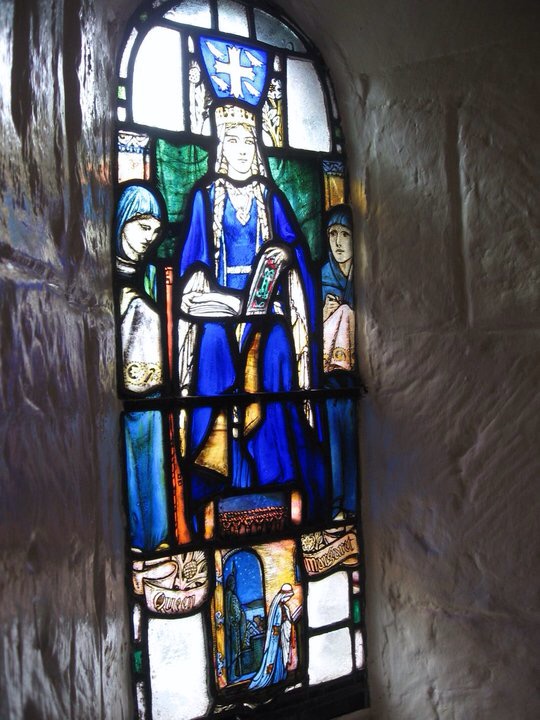
At Edinburgh Castle, I always set aside a few minutes to visit the oldest building in the city.  Saint Margaret’s Chapel dates from the twelfth century.  Margaret was the wife of King Malcolm III.  With her gentle influence, she helped to civilize and educate the Scottish court.  She and her royal husband were revered for their good deeds and charitable works.  To honor his mother, David I built the tiny chapel in her memory in 1130.  Today, Saint Margaret’s Chapel offers a small corner in the bustling castle where tourists can pause and enjoy a quiet moment of reflection.

stmargaret

Photo by L. Walkins, 2010

Delicate sunshine filters through the colored glass illuminating the gentle features of the saintly queen.  Standing before the window, Elizabeth Ann looks around the small stone chamber,  letting her gaze follow the swirl of reflected blues and greens splashed across the stone floor.  Slowly, she retreats to one of the benches lined up against the wall across from Saint Margaret’s stained glass portrait.

She sits and closes her eyes.  An unbidden image of a man with shaggy straw-colored hair, a narrow face, and twinkling light brown eyes fills her mind.  Sebastian.  She wonders what he is doing.  The last time they saw each other was in Paris.  They had visited Sainte-Chapelle to admire its famous stained glass.  Sebastian knew everything about the history of that chapel.  He had linked arms with her as they gazed up at the towering windows, entertaining her with a plethora of random facts until, laughing, she had retreated to the gift shop.  If he were here now, what would he tell her about Saint Margaret and Edinburgh Castle?

Opening her eyes, Elizabeth Ann looks through her  guide book.  She studies the map of the castle and rises to her feet.  With one last glance at the saintly queen’s wise face, she pushes her memories to the back of her mind.  Sebastian is married to someone else.  He is part of her past.  That’s all.

Elizabeth Ann turns her back on what might have been and steps out into the afternoon sunshine.


Words and Photos: Welcome Home

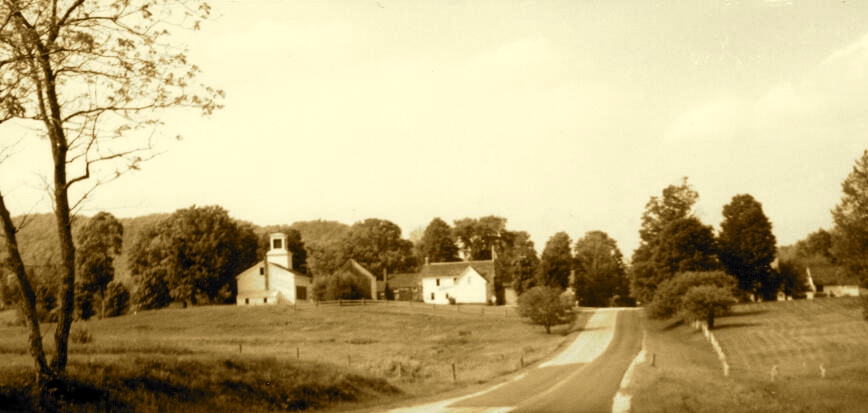
Best known as a breath-taking winter destination for skiers, Vermont is also beautiful during the summer.  While enjoying a relaxing June weekend in the Green Mountain state, the scenic view of this  gracious and comfortable farmhouse caught my eye.

Welcome Home

Photo by L. LeVasseur, 1991.gfgt

Photo by L. LeVasseur, 1991

The white, clapboard house stands patiently waiting.  From its stone foundation, the hills and meadows of the New England countryside unfold like a verdant patchwork quilt.  Golden sunlight streams through its sparkling windows, filling the rooms with a mellow glow.  The farmhouse is empty now, but earlier in the day the parlor, kitchen and stairway had echoed with the kind-hearted industry of several aunts and cousins as they made preparations for the newlyweds, who are due to arrive at any moment.

As the sun dips below the horizon and the stars slowly appear above in the deepening lavender twilight, the house is silhouetted against the stark beauty of the mountains, a beacon to the young couple.  A shining black “Tin Lizzie” rattles down the lane and stops in the yard.  An elegantly dressed man extracts himself from the driver’s seat. He runs around to the passenger side of the open motor car.  Doffing his top hat, he extends a hand to his bride.  She places her hand in his and alights from the vehicle. The diaphanous folds of her white gown flutter in the evening breeze.  Arm-in-arm they climb the steps of the wide front porch.  The groom slips a key from his vest pocket and opens the front door.  As they step inside, the house welcomes them content in the knowledge that now it has become a home.