
English Cottage Kitchen, Thorne Collection (photo by L. Walkins 2010)
My favorite gallery at the Art Institute in Chicago houses a collection of miniature rooms commissioned by Mrs. James Ward Thorne (Narcissa), who turned her childhood fascination with dollhouses into a life-long vocation to recreate in meticulous detail a variety of decorative interiors from England, France and the United States. I stumbled upon the Thorne gallery at the end of our museum visit, so I had time to view just a few of the beautiful dioramas, including these two reproductions of a Virginia Dining Room (circa 1800) and an English cottage kitchen from the Queen Anne period. Nevertheless, the lovely rooms struck a chord in my imagination and inspired me to write the photo essay below.
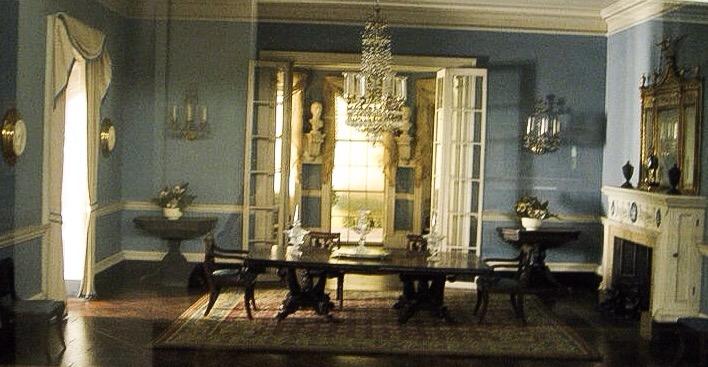
Virginia Dining Room, Thorne Collection (photo by L. Walkins 2010)
“Everything is so tiny and perfect,” Elizabeth Ann said, clasping her hands and staring in wonder at the pale pink dollhouse. “Look Cat, the shelves in the library are even filled with little books.”
She flung her arms around her Aunt Catharine’s waist in a grateful hug and then sat cross-legged on the floor, letting her gaze roam across the three floors of miniature rooms. She couldn’t believe the dollhouse that used to reside under the eaves of Grammy Merriweather’s attic next door to a gigantic steamer trunk now filled the corner of her very own bedroom. Her aunt had driven it over in the back of the station wagon while Elizabeth Ann was at school.
Cat knelt down beside her and affectionately tugged one of her dark braids. “I hope you were surprised.” She grinned as Elizabeth Ann nodded solemnly. Reaching into her sweater pocket Cat pulled out a package wrapped in tissue paper. “Here, I almost forgot. You have to have a family to live in the house, don’t you?”
Eagerly, Elizabeth Ann opened the package and placed the four china dolls in her lap. There was a mother, a father and two children in the doll family. They wore old-fashioned clothes and cheerful smiles.
“I think the boy and the girl are twins,” Cat said.
“Like me and Edmund,” Elizabeth Ann observed, holding the children up, one in each hand. “They do look alike.”
“So, which room do you like best?” Cat asked. “My favorite has always been the dining room. The wallpaper is such a pretty shade of blue and the chandelier adds just the right touch of elegance.”
Beginning with the basement kitchen filled with sturdy wooden chairs and cunning pitchers and plates, Elizabeth Ann considered each room, tapping her finger against pursed lips. Cat was right about the dining room. It was really pretty, but so was the living room. The long couch with its needle-point pillows and a hand-knit afghan looked so comfortable. Each of the four bedrooms on the second floor had beautiful flowered wallpaper and carpets. Plus, everyone in the doll family got to sleep in a canopied bed.
Glancing at her neatly made twin bed by the window, Elizabeth Ann sighed and then returned her attention to the doll family’s house. At last, she came to a decision. “I think the music room is my favorite,” she said. “I wish we had grand piano like that one for my mom to play.”
“That’s very sweet of you, hon.”
Elizabeth Ann turned around at the sound of her mother’s voice. “I think it was sweet of Aunt Cat to bring me her dollhouse. Is it really mine to keep?”
“Of course,” Mom and Aunt Catharine said at the same time. They both laughed and added, “Jinx! You owe me a Coke.”
“Actually, the coffee’s ready, Cat,” Mom said. “And I just took some peanut butter cookies out of the oven, Elizabeth Ann.”
“Mmm, I can smell them from here,” Cat said, standing beside Mom in the doorway. “We’d better go and get some before Edmund comes in and eats them all.”
“I’ll be there in a minute,” Elizabeth Ann said.
Carefully, she sat each member of the doll family around their miniature dining room table. “You wait here,” she said and then got up to follow her mother and aunt to her own sunny kitchen.
As she skipped down the hallway, Elizabeth Ann’s imagination overflowed with stories of the old-fashioned china doll’s adventures in their pale pink home.
 Words and Photos by Linda A. LeVasseur