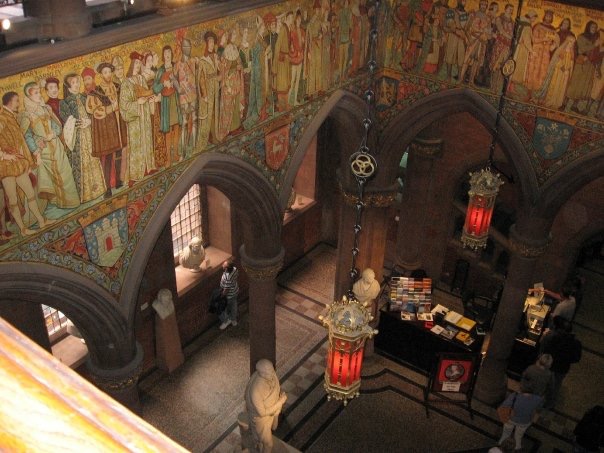
Whenever I visit an art museum, invariably my favorite paintings are the portraits. I enjoy studying the faces and clothing of the subjects and wondering about their personalities and lives. Edinburgh has a wonderful National Portrait Gallery on Queen Street in New Town. The collection includes pictures of many literary and royal luminaries. Upon entering the museum’s Great Hall, I always marvel at the gilded murals adorning entrance hall’s balcony. The procession of Scottish dignitaries includes Stuart kings and queens, poets, scientists and philosophers. In the short story I am currently writing, my character, Elizabeth Ann, visits the portrait gallery with her friend, Maude and experiences a moment of clarity.
Photo by L. Walkins, 2006
Outside, wispy clouds stretched across the blue summer sky. Shoppers and tourists crowded the sidewalks of Castle Street. Maude and I headed up the block and turned right, walking past the Queen Street gardens. Behind the wrought iron railings enclosing the park, I glimpsed rolling green lawns and the roof of a Grecian temple.
Maude walked quickly, leading me along the shaded sidewalk. “It’s a shame Will couldn’t come along on your vacation,” she said, as we approached the National Portrait Gallery.
“He wanted to, but he has a big case going to trial soon.” My boyfriend, Will was doing well at his law firm and hoped to make partner soon. Following Maude into the museum, I wondered what Will was doing back in San Diego. I looked at my watch. With the time difference, he was probably sound asleep.
“Wait here,” Maude said. “I’ll get us a map.”
I nodded, pausing in the middle of the sumptuous room to look around. My eyes were drawn to the gilded frieze that decorated the balcony above me. A procession of Scottish dignitaries filled the upper reaches of the hall. In one corner, I spotted Queen Mary and her consort, Lord Darnley dressed in splendid finery. The couple stood proudly among the crowd of leaders. Mary, in particular, looked like she was born to rule.
Maude returned and unfolded the visitor’s map of the different galleries. “Where shall we begin?” she asked. “Literary figures or the royals?”
Glancing up at the figure of Queen Mary once more and thinking back to the day Maude and I became friends, I said, “Why don’t we find a portrait of your favorite queen?”
Maude and I had met during my semester abroad at Regent’s College in London. Spotting me at Westminster Abbey one Saturday, she reminded me that we shared a public speaking class and insisted we spend the afternoon together. Taken in by her candor and exuberance, I had followed her into the abbey and right over to the tomb of Mary Queen of Scots.
“Excellent idea,” she said now, consulting the map. “She’s on the second floor. Follow me.”
We climbed the stairs and found the Scottish queen’s portrait. She wore a white hood and veil and looked out at us with sad eyes.
Leaning forward, I read the placard beside the painting. “It says she’s dressed in traditional French mourning. It seems weird that white was the color for mourning back then.”
“Poor Mary was absolutely devastated when her French husband died.” Maude fiddled with the end of her long, blonde braid. “The royal family had no use for her anymore and they cast her aside.”
“Being a sixteenth century woman was pretty horrible,” I said. “Can you imagine having no control over your own fate? Like all those poor women who married Henry VIII.”
“Dreadful.” Maude folded her arms as she studied the portrait. “Mary was just 19 when she came home to Scotland to rule. When I was 19, I had enough trouble managing my classes at university, let alone ruling an actual country.”
Thinking about Mary’s life moving from castle to castle in medieval Scotland, I wandered across the small gallery. “At least she didn’t have to worry about where she was going to live,” I said with a laugh. “In Edinburgh alone, she had the castle and Holyrood Palace.”
“I know,” Maude agreed. “It must have been some comfort to depend on centuries of family tradition.”
We drifted slowly through the glass doorway to the next gallery. As I studied the portraits, I considered my family and our traditions. Even though, I’d been living in my own apartment for a few years, I called my parents’ yellow bungalow in Mission Hills home. All of our family celebrations still took place around my mother’s dining room table.
Tonight, Maude and her husband were throwing a housewarming in their amazing new flat. For sure, the first of many parties. Maybe it was high time I too began some new traditions in a real home of my own.